Arrive in the session.
Coach readiness check, mobility and progressive movement. Explain the day’s cue and demonstrate the stations. The first net pairs put on protection; others start unpadded. Equipment setup happens before class.
 WBLTHE SPORT
WBL / THE COACH PLAYBOOK
A repeatable class with room for individual coaching.
The WBL class format · Adults · 12 players · Six pairs · Two machine nets · Lead coach + dedicated replenisher. Your coach manages the rotation, pace and player readiness.
01 / SIXTY MINUTES, USED WELL
Coach readiness check, mobility and progressive movement. Explain the day’s cue and demonstrate the stations. The first net pairs put on protection; others start unpadded. Equipment setup happens before class.
Six 8-minute blocks: 7 minutes working, 1 minute to stop, change and prepare. Batters split net time equally with short coach-managed turns. Pause machines for every handover.
Walk, breathe, check in. Each player names one useful cue. Coach confirms recording/upload status and flags clips to review. Pack-down and fuller video review happen outside the class.
2 nets × 500 deliveries/net-hour × 42 working minutes ÷ 60 ÷ 12 players = about 58 balls each. The 500 rate is founder-reported from previous machine sessions with a dedicated replenisher, an operating reference rather than a guaranteed class count. Actual volume depends on player readiness, equal turns and coaching needs.
THE SCIENCE BEHIND THE SESSION
Read the story behind the method, or open the themed playbook for station instructions and a rotation planner for 6–12 players.
The art & science of batting →Themed session playbook →02 / FOLLOW YOUR PAIR
Every station develops a defined element: contact, decisions, strength, acceleration, aerobic fitness or readiness. The coach sets the exercise, pace, load and recovery for the group.
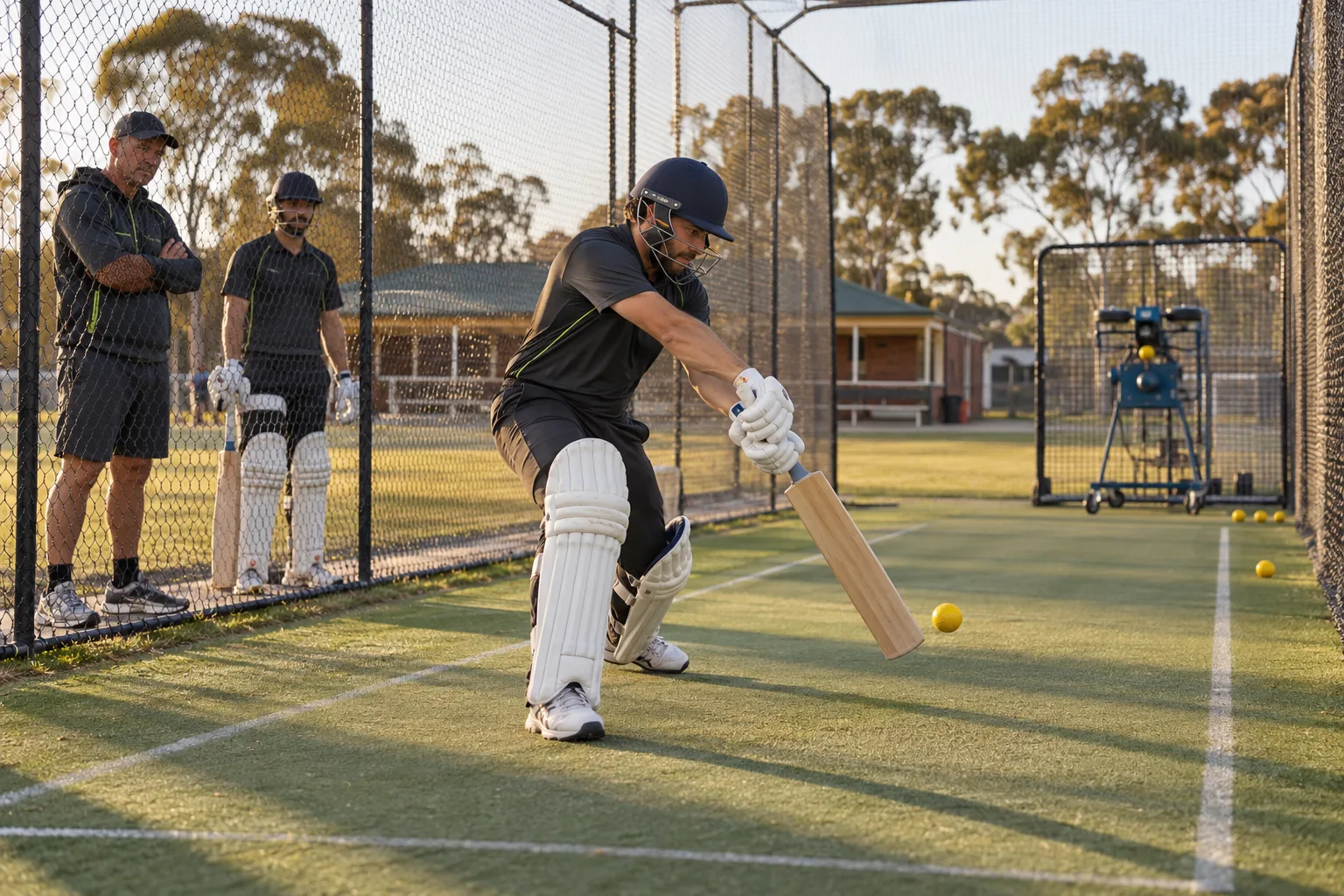
Both players wear full batting protection. One bats; the partner observes from a protected position outside the active lane. Work in roughly 12-ball turns, stopping the machine before each swap. The coach gives one short cue and records the current batter on that net’s phone.
| Time | Net A | Net B | Strength | Speed | Engine | Reset |
|---|---|---|---|---|---|---|
| 08–16 | Pair A | Pair B | Pair C | Pair D | Pair E | Pair F |
| 16–24 | Pair F | Pair A | Pair B | Pair C | Pair D | Pair E |
| 24–32 | Pair E | Pair F | Pair A | Pair B | Pair C | Pair D |
| 32–40 | Pair D | Pair E | Pair F | Pair A | Pair B | Pair C |
| 40–48 | Pair C | Pair D | Pair E | Pair F | Pair A | Pair B |
| 48–56 | Pair B | Pair C | Pair D | Pair E | Pair F | Pair A |
Each pair visits both nets and every other station once. Nets are adjacent in the rotation; Pair B starts in Net B and finishes in Net A, so its batting blocks are split. Rotate starting stations between classes. Reset precedes Net A; the coach allows additional gear-change time whenever needed. Remove pads for lifting and general sprint conditioning. Controlled cricket-specific running with protection is a separate coach-led progression.
03 / KEEP THE LANES RUNNING
A dedicated replenisher manages compatible machine balls, feeder refills and equipment checks. Keep enough balls for several feeder loads and stop the machines for every handover or collection.
Automatic feeders keep delivery consistent. Your coach chooses the machine settings and pace to suit the player and task.
The lead coach keeps sight of the stations and adapts the work to the group. Add fitness supervision where the site or participants need it.
Separate running lanes from net exits, provide recovery space and make the next player’s preparation part of the rotation.
04 / A WEEK WITH A PURPOSE
| Day | Batting focus | Physical focus |
|---|---|---|
| Monday / Precision | Balance, contact and predictable feeds | Controlled strength and easy aerobic work |
| Tuesday / Engine | Repeat a scoring option | Scaled running intervals; moderate loads |
| Wednesday / Build | Direction and repeatability | Strength technique; low running volume |
| Thursday / Decisions | Coach-cued variation; leave or play | Quality acceleration, generous recovery |
| Friday / Reset | Technical refinement and video cues | Mobility, easy movement and recovery |
| Saturday / Apply | Scoring games; scheduled live-bowler transfer | Social circuit; periodic fresh benchmarks |
Example weekly timetable: four bookable classes per day, six days per week. Choose times with local members; contact us for local coaching availability. Unlimited bookings do not mean every session should be hard. Coaches plan weekly load and protect recovery.
05 / DELIBERATE PRACTICE, MADE SOCIAL
Set an observable task: keep balance after contact, play straight to a gate, or leave the right ball. Choose an appropriate challenge.
Coach observes a small block, gives one cue and lets the player try it. Count successful decisions and controlled contacts, not just swings.
Coach selects two useful clips and one next action. WBL assists clipping and private sharing; the coach interprets the movement.
Keep a consistent benchmark, then introduce variation. Include live bowling to assess whether machine practice transfers.
Machine and live-bowler practice provide different information. Use controlled feeds to refine a task, then live bowling to practise reading and responding to the complete delivery. Pinder and colleagues: information and movement in batting.
06 / A GRADE YOU CAN EXPLAIN
Three profiles. No single score that confuses them.
The coach starts each player at an appropriate batting grade after an induction. Record the machine settings, ball type, feed distance, target zones and assessment version so results are comparable. Use consistent tasks and coach judgement. These programme grades track progress against defined coaching criteria. See the evidence-led progression guide.
| Grade | Training emphasis | Progression evidence |
|---|---|---|
| 01 / Foundation | Safe preparation, stable setup, predictable feeds | Safety induction and an appropriate starting profile. No minimum fitness score. |
| 02 / Control | Contact and direction on controlled deliveries | At least 60/100 on the defined Control assessment on two separate days; safe routine throughout. |
| 03 / Adapt | Leave/play choices and controlled variation | At least 70/100 on the Adapt assessment twice, including at least 70% of available decision points. |
| 04 / Compete | Scenario decisions and repeatable scoring options | At least 80/100 on the Compete assessment twice, plus coach-observed transfer against live bowling on two occasions. |
Ten controlled straight balls, ten direction targets, ten leave/play decisions and ten scenario balls. Assess when fresh, at most one block of assessment per planned benchmark session; a full assessment can span sessions.
Every delivery: 0 = not achieved, 1 = partial, 2 = achieved for each applicable skill category. A correct leave earns execution credit; an invalid feed is re-bowled. Five routine checks score 0–2 each. Formula and profiles are in the coach brief. A safety failure pauses the assessment regardless of total.
Compare with your own baseline. Fitness does not block batting promotion. No rewards for maximum weekly attendance, playing through pain or selecting heavier equipment. Formal speed comparisons need consistent timing equipment.
Reassess every four to six weeks, not every class. Reassess targets after a layoff. Keep personal results private by default; optional challenges compare the same assessment profile and conditions. Raw shot totals never determine skill grade.
07 / FROM CLASS TO COMPETITION
Train the elements. Bring them together in a shared challenge.
Start with coach-judged batting challenges, personal-best fitness benchmarks and team consistency. Later, develop verified WBL events with published delivery settings, scoring zones, judging, divisions and equipment calibration. Class grades record local training progress; formal events require common standards and verified judging.
Talk to the coaching team ↗