
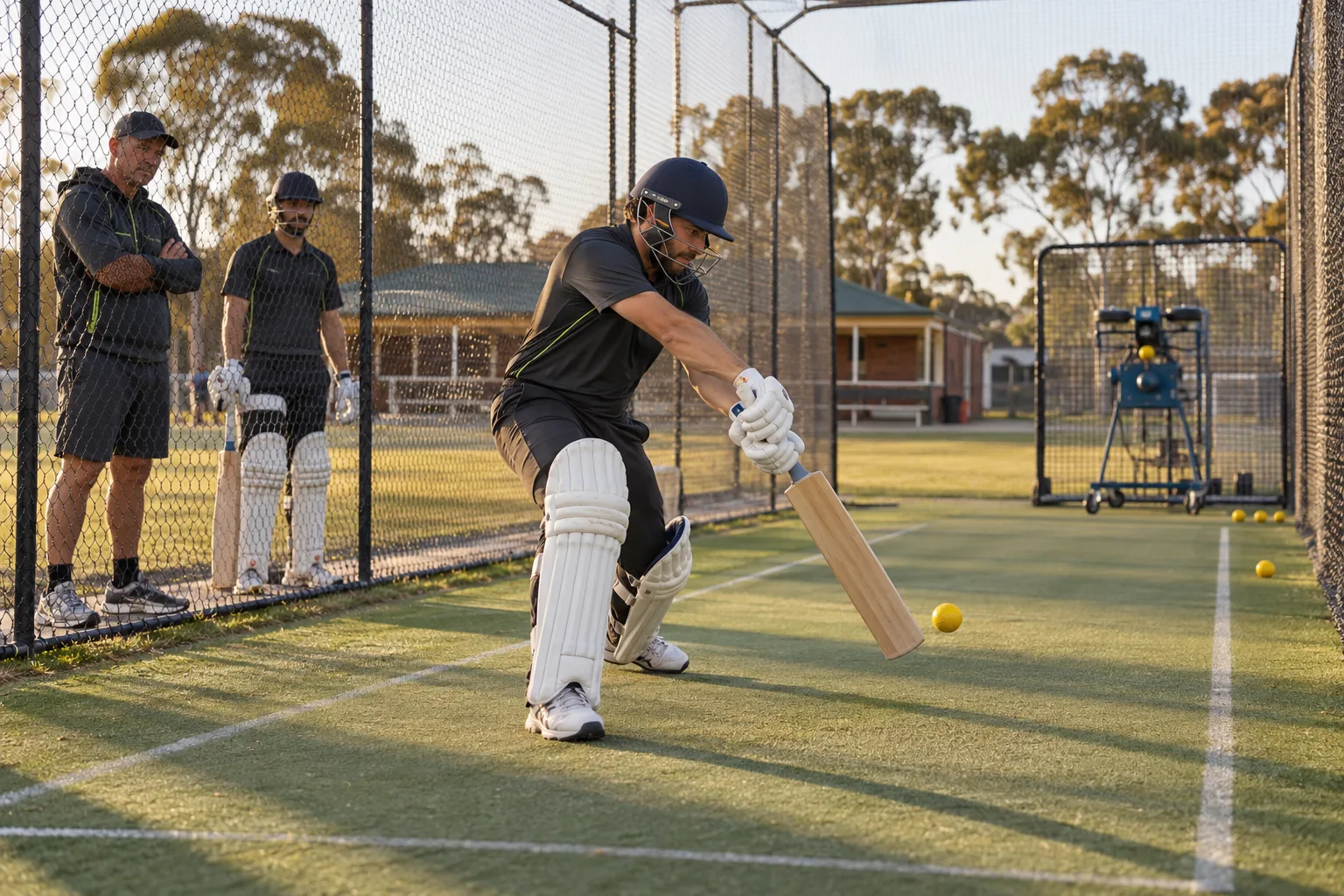
There is a particular satisfaction in meeting a cricket ball cleanly. The movement feels organised. The impact sounds right. For a moment, something difficult feels simple.
Getting to that moment involves much more than swinging a bat. A batter has to gather information, anticipate where the ball will go, choose a response and coordinate the body to deliver it. Then comes another ball, with another problem. The player must do all of this while managing effort, uncertainty, expectation and the consequences of the previous delivery.
That is what makes batting such a compelling subject for coaching. It is a craft with a long memory and a continually expanding science. Tradition gives us a vocabulary for the game. Research helps us examine how players actually learn. Good coaching brings those perspectives together in the next task a player attempts.
To understand the opportunity in front of us, it helps to begin with how the task itself has changed.
A game that keeps evolving
The shape of the cricket bat tells a story about adaptation. The ICC’s history describes a transition after about 1760: bowlers increasingly pitched the ball rather than rolling it along the ground, and the straighter bat replaced the older curved, hockey-stick-like form. The problem presented to the batter changed; the tool and the response changed with it. [1]
Cricket also became more formally organised. Marylebone Cricket Club was established in 1787 and issued a Code of Laws the following year. Shared laws helped give a diverse game a common structure: players could train for recognisable problems and compete under agreed conditions. [2]
The same relationship between conditions and technique remains useful when thinking about batting today. A player defending a good-length ball on a lively surface faces a different problem from a player searching for a boundary into an open part of the field. The available time, the bounce, the field and the value of taking a risk shape the response. A beautiful-looking movement is only useful if it solves the problem in front of the batter.
For a coach, this suggests a practical starting point: ask what the player needs to achieve. Protect the wicket? Find a single? Place the ball through a narrow gap? Attack a particular delivery? The answer gives technique a purpose. It also makes progress easier to see. We can observe whether the player is doing the thing they intended to do, under the conditions they intended to do it.
From instruction to understanding
Coaches have been trying to explain batting for a very long time. John Nyren’s The Young Cricketer’s Tutor, published in 1833, includes advice about position, the hands on the bat and the danger of over-hitting and losing balance. Read as a historical document, it shows how recognisable some of the coaching questions already were: where should the player stand, how should the bat be held, and how much effort is useful? [3]
A manual can preserve hard-won experience. It gives a learner somewhere to start and a coach a language for explaining a movement. Demonstration has a similar value: the player sees an action and begins to build an idea of what they are trying to achieve.
The next challenge is adapting the instruction to a person. Two players can hear the same explanation and need different tasks. One may understand the target but struggle to coordinate the stroke. Another may move comfortably against predictable feeds and struggle to choose a shot when the delivery changes. Giving both players the same technical correction misses the difference between their problems.
Modern coaching makes room for this distinction. The Australian Sports Commission describes a participant-centred approach that adapts to the person and develops physical, social, psychological, cognitive and sporting skills together. The ECB’s coach education likewise identifies player-centred coaching as a core capability. [4] [5]
This broadens the coach’s job. Explain and demonstrate when that helps. Observe what the player actually does. Ask questions that reveal what they noticed. Change a task when the current one is teaching the wrong thing. Then judge the session by the quality of the player’s learning, as well as by how smoothly the coach delivered it.
How training became a science
The history of coaching sits alongside another history: the effort to understand how the human body responds to work. A. V. Hill’s research on muscle energetics, recognised in the 1922 Nobel Prize, helped place muscular work and recovery within a measurable physiological framework. His 1923 Nobel lecture discusses experiments on muscle heat and human oxygen consumption. These were steps towards explaining exertion through measurement, rather than judging it only by how hard it looked. [6]
Resistance exercise developed its own research tradition. Thomas DeLorme’s 1946 paper, Heavy resistance exercises, is an early published landmark in that literature. Today the evidence base extends far beyond a single exercise system: the American College of Sports Medicine’s 2026 position stand draws together 137 systematic reviews of resistance-training research. [7] [8]
The practical significance is specificity. Training has an intended adaptation. Strength work develops the capacity to produce force. Endurance work develops the capacity to sustain activity. Skill practice develops a response to a task. Each needs an appropriate challenge, repeated exposure and a way to assess the result.
For batting, that means asking a better question than “Was the session hard?” A session can be physically demanding while giving the player little opportunity to solve a technical problem. Equally, a carefully coached contact session can be productive without leaving the player exhausted. The workload should serve the adaptation.
A coherent programme therefore contains different kinds of days and different kinds of effort. Some work asks for concentration and precision. Some asks for substantial force. Some develops repeated running. Recovery allows the player to return ready for the next useful exposure. The coach connects those pieces across the week, around matches, work and the rest of the player’s life.
What the state of the art looks like
State-of-the-art coaching is a set of decisions, supported by tools. What does this player need? What task will reveal it? How much challenge is appropriate? Which information matters? When should the coach intervene, and when should the player have another attempt?
The most useful session starts with a clear observation. Suppose a batter frequently closes off an intended scoring area. The coach first needs to understand the context. Does it happen against one length? Only when the player is rushed? Only when they try to hit harder? The task can then isolate an important part of the problem while keeping the intended outcome visible.
That might mean a comfortably paced feed and a broad gate to begin with. The player tries to send the ball through the gate, explains the attempt and makes an adjustment. Once the response is reliable, the coach can narrow the gate or vary the delivery. This is an example of practice design: arranging the environment so that the player has a useful problem to solve.
The coach also distinguishes performance during practice from learning that remains available later. A player may succeed with a cue after every ball. The next question is whether they can do it tomorrow with less help. Then whether they can do it when the delivery changes. Then whether they can select and execute the response against a live bowler.
Technology strengthens this process when it answers a question. Video can settle what happened during an attempt. A consistent timing method can show a change in sprint performance. A training record can show whether the workload actually progressed. The value is in the decision each measurement helps the coach and player make.
Hand–eye coordination begins before contact
“Watch the ball” is familiar advice, but batting perception is more interesting than a single instruction suggests. Research by Mann, Spratford and Abernethy examined gaze and head movement in two elite and two club batters. It described predictive eye movements and head tracking during interception. The study gives a close view of skilled behaviour, rather than a universal gaze pattern every player should copy. [9]
A useful coaching implication is to preserve the connection between seeing, choosing and acting. A batter reads information for a purpose: to decide what to do with the delivery. Practice can make that relationship explicit. Give the player a task that includes a choice, then ask what information they used to make it.
Bowling machines and live bowlers contribute different information. Pinder and colleagues found that changing between bowler, machine and video conditions changed batting movement organisation. A machine offers repeatability, while a live bowler supplies approach and release cues as part of the delivery. [10]
This gives us a constructive division of labour. Use controlled feeds to work on a defined contact or placement task. Introduce suitable variation to connect the stroke to a decision. Include live bowling to practise reading the complete action. Each environment has a role in the programme.
Consider a leave-or-play exercise. The coach defines a playable zone and the player’s objective. A correct leave is a successful decision, even though the bat never meets the ball. A forceful stroke at the wrong delivery can be poor task execution, even when contact sounds impressive. Separating decision and execution makes the feedback more useful.
Deliberate practice: give each repetition a job
Ericsson, Krampe and Tesch-Römer’s 1993 work on expertise put structured, improvement-directed practice at the centre of a major research programme. The important features were the design of the activity, attention to a specific weakness, informative feedback and opportunities to refine performance. Ericsson and Robert Pool later brought the ideas to a wider audience in Peak. [11] [12]
For a batting session, the distinction becomes tangible when the goal becomes precise. “Have a hit” leaves many things unspecified. “Place this delivery through the straight gate while staying ready for the next movement” gives the player an intention and the coach something to observe.
Our practical application is a short learning cycle. Agree the task. Attempt a small block. Ask the player to describe what happened. Add one useful piece of feedback. Repeat with an adjustment. Once the task is under control, increase the challenge. The number of balls is a scheduling choice; the learning cycle is the important structure.
One player’s challenge might be a wider target at a comfortable pace. Another’s might be selecting between two scoring areas from a changing feed. Both can practise deliberately within the same class theme. Individualisation comes from matching the task to the player, not from requiring a completely separate session for everyone.
The research debate also clarifies what coaches should record. Macnamara and colleagues’ sports meta-analysis and Ericsson’s response disagree in part about which activities count as deliberate practice. That makes a simple hours total an incomplete description. A useful log says what the player worked on, what feedback they received and what changed. [13] [14]
Predictability first, uncertainty with a purpose
Repetition and variation both belong in learning. A stable task gives a player time to explore a solution. Variation asks the player to recognise when that solution is appropriate. Research on the order of sports practice does not support treating random practice as universally superior. The task and the learner matter. [15]
A coach might begin a placement task with one delivery profile, then add a second line, then introduce a field that makes one scoring option preferable. The challenge grows in a way the player can understand. If execution becomes chaotic, simplify the task and rebuild the connection between intention and action.
This is also how progress becomes explainable. The player can say, “I can now find that area against two delivery types,” rather than relying on the feeling that the session went well. The next session has a starting point.
Feedback that changes the next attempt
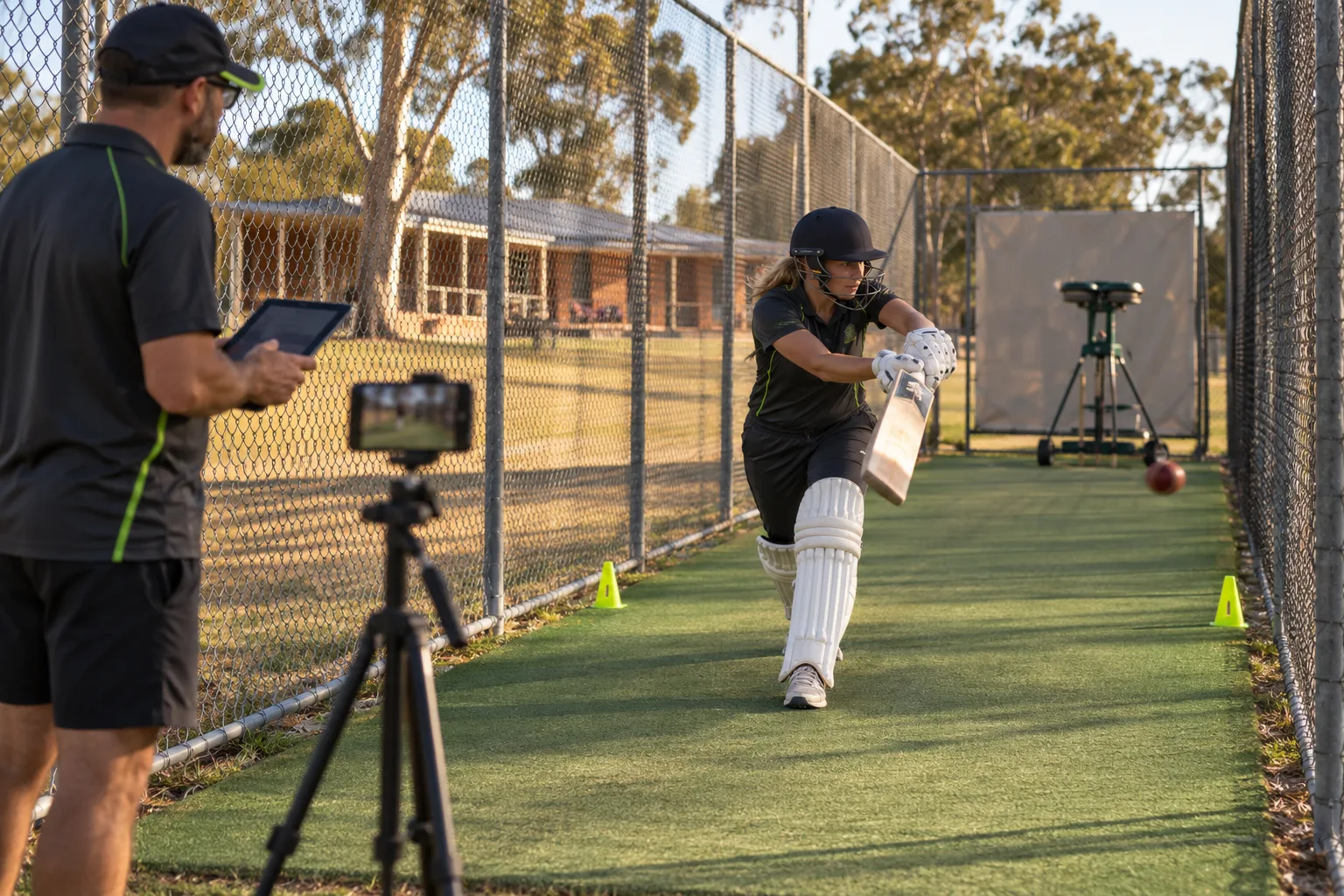
A recording is valuable because it makes an attempt available for inspection. It lets the player and coach revisit a decision, compare two strokes or check whether an intended adjustment was visible. Used well, a small number of relevant clips can keep a review focused.
Tissera and colleagues’ systematic review of cricket feedback research included eleven studies, with five entering meta-analysis. Anticipation-training studies often combined feedback with other methods; the review did not find an intervention isolating feedback alone. The useful lesson for programme design is to connect feedback to an active learning task. [16]
For example, pause before reviewing the clip and ask the player what they think happened. Did they choose the intended ball? Did the ball go where they aimed? What would they change? Then watch together. The clip becomes a way to compare the player’s understanding with the recorded attempt.
Finish with an action the player can use. “Try the next six with the same target and a more controlled attacking intent” is a task. A long list of technical observations may leave the player uncertain about where to begin. The coach chooses the priority and checks whether the change helped.
The same discipline applies to numbers. Contact rate needs a clear definition of contact quality. Decision accuracy needs a declared task. A correct leave should be recorded as a decision, with contact marked inapplicable. Delivery settings and target difficulty should accompany the result. These details make a training record interpretable across visits.
AI-assisted clipping reduces the work of finding moments in a long recording. WBL uses that capability to support review and player libraries. The coach still supplies the context: what the batter intended, whether the choice made sense and what to practise next. This is a practical way to put more useful observation into an ordinary club session.
Elite skill development: design the problem, then test the learning
Current cricket coach education explicitly includes manipulating practice environments, learning through problem solving and reflective practice. These appear in Cricket Australia’s updated representative-coaching curriculum delivered by Cricket ACT in 2025. The practical question is how to turn those ideas into the next delivery a player faces. [37]
Constraints-led practice: give the batter a problem worth solving
A constraint is something the coach changes to shape the task: the scoring area, available time, delivery range, field or rules. In our cricket application, a batter might earn a point for placing a suitable ball into a gap, with a separate point for correctly leaving an unsuitable one. The coach adjusts the problem until the player has to attend to useful information and find a workable response.
Take a player who drives every ball in a machine net. Start with a clear scoring gate and a predictable feed to establish contact. Then offer a safe, manageable range of lengths, including balls that should be defended or left. Finally, introduce a field and an over-level objective. The intention stays recognisable while the information becomes richer. Change one important demand at a time so the coach can see what the player has learned.
The constraint must preserve the cricket problem. A coloured light unrelated to a delivery can train a response to that light; it does not automatically train reading a bowler. A machine gives valuable repetition but omits the bowler’s approach and release information. WBL uses controlled practice for its specific job and connects the programme to live bowling for the fuller perception–action task. [10]
External focus: put attention on the effect of the stroke
A 2025 systematic review of 36 studies found that instructions directed towards movement effects generally supported more effective movement organisation than instructions focused on body mechanics. The findings varied with the task. [36]
For a WBL batting block, a coach might try “send the ball through the gate” or “land it in the scoring zone”. Technical explanation still has a place between attempts. During execution, agree one usable cue and observe whether it helps this player achieve the intended result. Avoid turning every delivery into a checklist of joints.
Calibrate challenge and reduce help
Our progression has three questions. Can the player solve the task under controlled conditions? Can they solve it with a meaningful change? Can they reproduce it later with fewer prompts? A narrower target is one progression; a wider range of deliveries is another. They should not both increase simply because a calendar week has passed.
A coach-designed example is a short placement block, a varied block and a later return to the original task without the cue. Record suitable deliveries, decisions and target hits separately. A higher contact score after every-ball instruction is useful session information; retained performance at the next visit tells the coach something different. Add live-bowling observations before interpreting net progress as match readiness.
Video, anticipation and the emerging role of VR
In a one-net session, the off-net Decision Lab can pause a bowler clip around release, ask the player to predict length or choose a response, then reveal what happened. This is a coach-led anticipation exercise. The clips need to show the relevant information, and the player’s response needs checking later against real deliveries. Watching a clip and executing a stroke remain different tasks. [16]
Virtual reality is an active research frontier. A 2026 study tested 50 players from a women’s professional cricket pathway. Its simulator partly distinguished batting roles, but high wicket loss and questions about movement fidelity remained. It tested assessment validity, rather than demonstrating that VR practice improves match batting. [38]
That distinction guides WBL’s technology choices. Recording and shot review support observation today. Immersive simulation, automated anticipation tests and laboratory-grade movement measurements need their own validation before becoming training promises. For every tool, ask which decision it improves and whether that improvement survives outside the tool.
Strength, power and the movement behind the stroke
Strength and power deserve a clear place in batting preparation. Strength describes force-producing capacity; power concerns how quickly work is done. A player also needs coordination to use those capacities within the stroke.
Peploe and colleagues studied a range-hitting task in twenty batters and found relationships between bat speed, impact location and the speed of the struck ball. Taliep and colleagues found an association between upper-body strength and maximum hitting distance in eighteen elite provincial male batters. Together, these studies give coaches reasons to pay attention to both physical capacity and effective contact. [17] [18]
Physical preparation can be organised around familiar movement patterns: squat, hinge, push, pull, carry and trunk control. The exercise is selected for a capacity the coach wants to develop. A manageable load and repeatable technique establish the starting point. Progress can then be recorded in resistance, repetitions or the quality of a defined movement.
The ACSM’s 2026 position stand supports progressive resistance training for strength and other physical capacities in healthy adults. It also reports that training to momentary muscular failure does not consistently improve outcomes. This gives community coaching room to build productive strength work with appropriate effort and recovery. [8]
Within a batting circuit, the strength station has a time budget. Two familiar exercises with controlled sets and recovery can fit the class. A player seeking a larger strength adaptation can do additional supervised training across the week. The programme should account for that total workload rather than pretending every physical goal is served by the same seven-minute dose.
What the 2026 strength guidance means in practice
The ACSM update distinguishes the training goals: heavier loading supports maximal strength, while moderate loads moved with fast lifting intent support power. Coaches select the load, movement and volume for the desired adaptation. [8]
In WBL, we apply that distinction through controlled strength work and, for appropriately prepared players, supervised power exercises. Technique and readiness establish the entry point. The coach tracks the total week, including gym sessions and matches, so the circuit contributes to a coherent progression.
Mobility is usable movement
Mobility work should help a player move comfortably through the positions their task requires. That starts with observation: can the player access the intended stance, step, turn or strength exercise without forcing the movement?
A meta-analysis by Alizadeh and colleagues found improvements in range of motion following resistance training with external loads. Strength and movement-range development can therefore complement each other. The coach can use appropriate exercise ranges alongside specific mobility work, guided by the player’s needs. [19]
At the nets, that might mean comfortable ankle movement, supported hip work or gentle thoracic rotation during preparation. Keep the objective clear and assess the movement being trained. An arbitrary flexibility contest adds little to the player’s understanding of their task.
Elite physical preparation: adapt the dose to the athlete
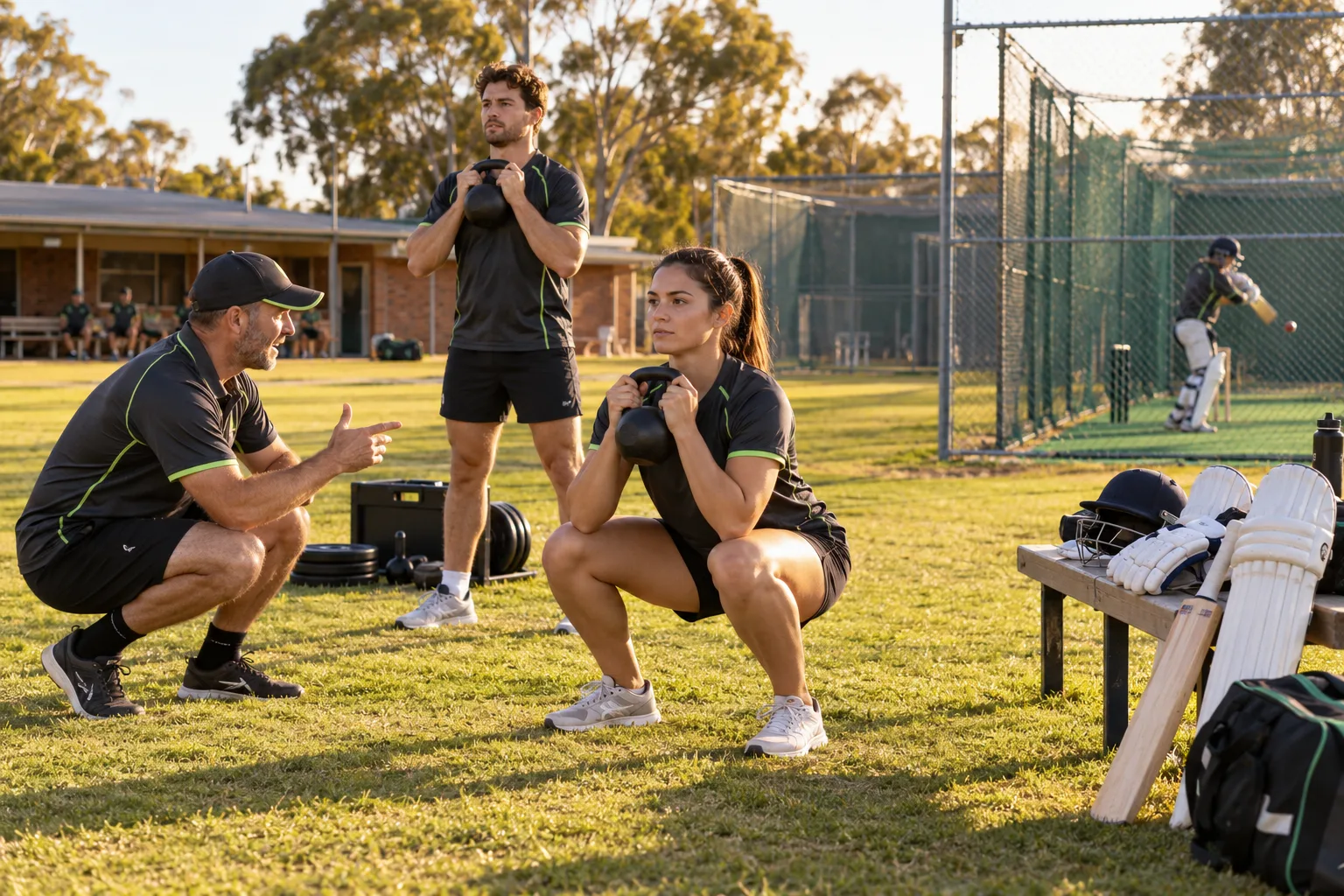
A shared circuit can have a shared purpose while players use different loads, exercises and recovery. The useful detail is what each person can do well today, how that relates to their recent work, and what adaptation the programme is pursuing.
Autoregulation and repetitions in reserve
Autoregulation means adjusting training using the athlete’s response. Repetitions in reserve is an estimate of how many further good repetitions the player could complete. Velocity-based training uses measured lifting speed to inform decisions. A 2026 network meta-analysis found favourable strength or jump estimates for some adaptive methods compared with fixed-percentage loading, but its rankings depended on the outcome and evidence base. It does not establish one universally best system. [34]
For WBL, our practical starting point is a coach-observed warm-up and a conversation about effort. A familiar strength exercise might finish with an estimated two or three good repetitions available. That is a programming example, not a requirement for every athlete. A novice needs help judging effort; an experienced lifter may give a more useful estimate. The coach can reduce the load, change the exercise or increase recovery while keeping the day’s purpose.
Record what was actually completed: exercise, load, sets, repetitions and the player’s effort estimate. Progress when the intended movement and effort are repeatable. A player returning after a long innings can have a different prescription from a rested teammate without being assigned a lower skill grade.
Velocity-based training: what the specialist equipment adds
The 2025 strength-coaching review by Thompson and colleagues explains how measured lifting velocity and individual load–velocity relationships can inform prescription and monitoring. Reliable measurement and an appropriate profiling procedure matter. [33]
A specialist coach with a validated device can use that information for an experienced athlete’s lifting programme. WBL’s standard circuit uses coach observation, load records and reported effort. Phone skeleton overlays are not a substitute for validated bar-velocity measurements, and this article does not describe an automatic velocity-based prescription feature.
Plyometrics, strength and power have different jobs
Plyometric work uses a rapid transition from loading to propulsion, as in an appropriately coached jump or hop. A 2025 review covering 70 studies in athletically trained adults reported improvements in several jumping, sprinting and physical-performance tests. These results support physical preparation; they are not measures of batting judgement or runs scored. [35]
In our circuit application, a prepared player can use a small number of quality jumps with recovery, while another practises controlled landing or a simpler strength movement. The coach chooses a suitable surface, clear space and a progression the player can control. The batting relevance is the capacity to produce and absorb force; the stroke and wicket turn still need their own practice.
Complex training combines resistance and plyometric work. A 2026 controlled trial in highly trained male footballers examined an eight-week programme and reported improvements in laboratory measures of knee-muscle performance. It supports interest in combining those training modes, but does not show that lifting immediately before batting improves the next shot. [40]
For a community class, the coach can distribute strength and power emphasis across the week. A demanding lift followed immediately by an explosive drill is an advanced option requiring appropriate preparation and supervision, not a default station recipe. The programme earns its sophistication through the right dose and sequence.
Acceleration, braking and reacting to the run
Our Speed station separates three coaching tasks. First, accelerate over a short, clear distance. Second, learn to slow down and turn under control. Third, introduce a partner’s call and the decision to continue or return. The reactive task adds uncertainty to the physical action. A fast pre-planned shuttle and a well-judged cricket run deserve separate records.
Start the turn slowly, progress the movement, then add speed and a decision. Use adequate recovery for quality speed attempts; use the Engine station when repeated effort is the intended demand. Change-of-direction practice needs stopping room and an appropriate surface. The goal is a reproducible action, not winning a race through an unsafe turn.
Running between wickets is a skill—and a physical demand
A completed run includes several actions: recognising the opportunity, making a call, accelerating, managing the bat, reaching safe ground and preparing for the next decision. A fast straight-line sprint is one part of that sequence. The turn and communication deserve their own practice.
Teach the sequence at a controlled speed first. Agree who calls in the scenario, rehearse the response, practise grounding and organise the turn. Then increase pace while keeping the intended actions. Separate running lanes and sufficient stopping space let players concentrate on the movement.
General speed development also benefits from physical preparation. Seitz and colleagues’ meta-analysis found that improvements in lower-body strength transferred positively to sprint performance across the included training studies. That supports combining strength development with quality running practice. [20]
For a short speed station, a few well-recovered efforts have a distinct purpose. The player is practising acceleration and controlled movement at speed. A fatigue-based shuttle set has a different purpose and should be programmed as such. Clear intent keeps the coach from asking for maximum speed while providing inadequate recovery.
The engine that supports repeated effort
Batting also calls for repeated activity over time. Houghton and colleagues studied a prolonged batting simulation with intermittent running in male club players. Their findings underline the value of tracking contact skill separately from physical measures. A player’s conditioning profile and batting profile tell different parts of the story. [21]
Aerobic training has a well-established role in developing cardiorespiratory fitness. Milanović and colleagues’ review found improvements following both endurance and high-intensity interval training in healthy adults. The programmes varied, so the practical decision is to choose a sustainable starting dose and progress the player’s weekly training. [22]
At community level, an engine station can begin with a measured run/walk format. A returning player and an experienced athlete may share the space while using different workloads. A fixed 400-metre effort is one possible task, rather than a requirement for every session. Measure the route, specify the effort and record the protocol when using it as a benchmark.
Theme matters here. A session focused on contact precision should preserve attention for the batting task. A conditioning emphasis can allocate more demanding work to the running station. The coach chooses the balance and reviews it alongside the player’s other training and matches.
HIIT: the intensity needs a purpose
High-intensity interval training alternates demanding work with planned recovery. Its value comes from the combination of intensity, duration, repetition and recovery. An exercise circuit becomes HIIT only when those variables create the intended high-intensity stimulus; moving between stations alone does not define it.
A 2026 review by Qi and colleagues pooled eighteen studies in trained athletes and found improvements in aerobic capacity following HIIT. Its results also show why coaches should specify the outcome: benefits were not consistent across every measure of physical performance. [26]
Three interval methods, different demands
Aerobic HIIT uses repeated high-intensity bouts with recovery, often aimed at accumulating demanding aerobic work. Sprint interval training uses very hard or all-out efforts, commonly lasting longer than a single short acceleration. Repeated-sprint training repeats brief sprints with incomplete recovery, developing the ability to reproduce those efforts. The mode, speed and recovery change what the session asks of the athlete.
Yang, Wang and Guan’s 2025 network meta-analysis included 51 studies and 1,261 athletes. All three interval approaches improved maximal oxygen uptake relative to conventional training, with no statistically significant difference between the three approaches. That supports choosing the method for the athlete and the task, rather than declaring one universal winner. [27]
For batting preparation, a recovered acceleration develops a different quality from a repeated-sprint set. The first prioritises the quality of an individual fast effort; the second asks the player to reproduce effort with restricted recovery. WBL gives the coach a clear choice between these tasks instead of blending them into an unspecified hard run.
Make the dose fit the class—and the player
A coach-designed introductory interval option for a prepared adult might be three 45-second hard, controlled efforts, each followed by 75 seconds of walking recovery. That occupies six minutes, leaving a minute for instructions within the station window. It is a practical scheduling example, not a research-defined optimum. Begin at a workload the player can repeat with control; returning players can start with easier run/walk work before progressing to high intensity.
Longer aerobic intervals and larger training volumes need their own time. A programme built around several multi-minute work bouts cannot be compressed into a seven-minute station while keeping its recovery intact. The coach can use a dedicated conditioning session when that is the appropriate dose.
Record the work duration, recovery, running distance or pace where measured, and the player’s perceived effort. For repeated sprints, record the individual efforts as well as any decline across the set. Progress one variable at a time and judge the response over repeated sessions. That gives “hard work” a clear training meaning.
Combine strength, fitness and skill intelligently
A batting programme develops several qualities together. Research on concurrent training helps explain how to organise them. Schumann and colleagues’ review of 43 studies found that combining aerobic and strength work generally preserved maximal-strength and muscle-size development, while explosive-strength gains could be reduced, particularly when the two types of training shared a session. [28]
Our programming response is to give each class a priority. On a power-focused day, use well-recovered efforts and keep the engine station easy. On a conditioning-focused day, programme the hard intervals deliberately and keep the other demands manageable. When a player is pursuing a substantial power or strength goal, use additional sessions and appropriate separation across the week.
The circular class rotation also means every player reaches the stations in a different order. A coach should therefore schedule fresh speed or skill benchmarks before the rotations, or at a separate assessment visit. Record task order and effort when reviewing mixed-circuit work. That makes the comparison useful rather than treating every recorded attempt as if it occurred under identical conditions.
Use a training record the coach can act on
A simple record can capture the information needed to adapt the week: attendance, session duration, perceived effort, completed strength work and the player’s readiness for the next task. Add sleep or soreness check-ins when useful to the coaching conversation. Look for patterns and discuss them with the player; no single readiness number should automatically decide whether someone is ready to train.
At review, ask two questions. Did the intended physical measure change under comparable conditions? Did the player complete the planned workload with enough recovery to keep practising the skill well? The answers guide the next block. Current sports science is most useful when it improves those everyday decisions.
The mental game can be practised
Batting creates repeated opportunities to react to success and failure. A player can execute a useful decision and still get an unwelcome outcome. They can also get away with a poor choice. Mental training gives the player a process for returning attention to the next controllable action.
A between-ball routine makes that process concrete. Step away. Take a deliberate breath. Check the situation. Choose one intention. Return ready to act. The exact sequence belongs to the player; it should be brief and familiar enough to use during play.
Rupprecht and colleagues’ meta-analysis found supporting evidence for pre-performance routines across sports. The 2026 umbrella review by Zhao and colleagues gives a broader view of psychological skills training, finding a varied evidence base with substantial uncertainty across interventions. The coaching application is to select a defined skill, practise it consistently and assess its usefulness to the athlete. [23] [24]
Imagery can be used as a rehearsal task: picture a relevant delivery, a chosen response and the next-ball routine. Self-talk can be made practical through a short cue connected to the task. Attention can be rehearsed by asking the player to identify what matters before a delivery and return to it after an error. These are coaching exercises to individualise, rather than a single script everyone must follow.
Pressure should also have a progression. Begin with a familiar task. Add a target or a simple scoreboard. Agree a challenge that matters to the player, then review how they responded. The coach watches decisions, routine use and recovery of attention, and asks the player what the experience felt like.
A missed target does not need a punishment lap. It needs an interpretation and another useful opportunity to learn. The aim is to give players a reliable way to respond when the task becomes demanding. Specialist psychological support belongs alongside coaching where the athlete’s needs extend beyond ordinary performance-skill work.
Training the mind for the next ball
The Australian Institute of Sport’s mental-performance education covers purposeful preparation, attention, emotions and competition plans, including resources for Olympic, Paralympic and Commonwealth Games athletes. That is a useful picture of what high-performance support makes explicit: mental preparation is something to practise throughout the week. [29]
An individual between-ball routine
Our cricket application is a short routine that fits between deliveries. Step back into a safe position. Notice the last ball and the current emotion. Take a comfortable breath. Choose the next intention. Return attention to the delivery information. A player might use “next ball” or “see the length” as their own cue. The routine should be brief enough to use in an actual innings.
Rehearse it after a good shot as well as a miss. Then ask whether it helped the player return to the task. Success is the ability to act on the next delivery even when frustration or nerves are present. The coach should not require a player to feel perfectly calm before they can perform.
A 2026 meta-analysis of interventions against choking found more consistent effects in closed-skill tasks than in open-skill contexts. Batting is open: the opponent and delivery keep changing. A reset can prepare attention, but the batter must remain responsive rather than attempting to follow a rigid mental script through the ball. [31]
Imagery that includes coping
A September 2026 scoping review maps mental imagery used for stress management. It shows varied approaches, often combined with other psychological skills, and does not establish a single imagery treatment or effect. [39]
For our Reset station, a coach-led example is to imagine walking out, taking guard, identifying a field gap and responding to a delivery. Include an awkward ball or a missed scoring opportunity, then rehearse returning to the next task. Ask what the player pictured and whether the sequence was useful. Some players prefer words or a physical rehearsal; the exercise should fit the person.
Pressure is a progression
The 2026 ESSA position statement recommends developing coping strategies before introducing pressure, building exposure gradually, explaining the purpose, monitoring the response and debriefing. It advises against excessive pressure or adding it while learning a new skill, and recommends collaboration with an accredited sport and exercise psychology practitioner. [30]
Our cricket application is a voluntary, coach-led challenge using a familiar task: for example, find three appropriate scoring opportunities in six deliveries with a field set. Count decision quality as well as execution. Start with a private score and progress to an agreed competitive scenario only when appropriate. Keep the feed safe; remove the pressure if it prevents useful practice.
The debrief asks what the player noticed, what they attended to and what they will try next. Avoid humiliation, fitness punishments and using a player’s private concerns as a source of pressure. More elaborate psychological interventions belong with a qualified practitioner.
Whole-player support
A 2025 review focused specifically on elite-athlete wellbeing found promising results for several psychological approaches, alongside limitations in the research. Wellbeing is an outcome in its own right; it cannot be inferred from a batting score. [32]
WBL’s coaching application is a brief private check-in, meaningful choice and a manageable next step. A player’s willingness to mention fatigue, nerves or a difficult week should help the coach adjust the session. A class provides practice and connection; it does not replace individual psychological or clinical care when that is needed.
The training environment is part of the method
A programme has to fit a person’s life if it is to become a habit. A player needs a reason to attend, a suitable challenge when they arrive and a sense that their work is going somewhere. The coach influences all three through the way the session is organised.
Teixeira and colleagues’ review of exercise and self-determination theory links autonomous motivation and perceived competence with participation. This gives a useful foundation for community training: let players help choose their goals, make progress visible and create an environment where effort is recognised. [25]
Partners can have purposeful roles. One bats while the other observes a single agreed feature from a protected position. At the running station, they rehearse calls. During a reset, they each name the next intention. The social structure supports attention to the work.
Competition works best when the task is clear. Compare players completing the same challenge under comparable conditions, or let a player compete against their own previous result. A shared target can bring energy to a session while leaving room for different starting points.
The coach’s job is to make that environment welcoming and exacting at the same time. Every player should understand what they are practising, what a useful attempt looks like and what progress would mean for them. That is how a group class can retain an individual learning focus.
Bringing the art and science to the local nets
WBL brings these principles together in a repeatable community format. The ambition is to make purposeful skill practice, progressive physical training, mental routines and useful feedback part of an ordinary training week—accessible through a local coach, a familiar group and a practical setup.
The starting format is twelve adults, two machine nets and six stations over an hour. A lead coach directs the session while a dedicated replenisher manages the machine-ball workflow. Recording phones capture the batting. The layout and staffing give each activity its own space and support the level of supervision the group needs.
The hour begins with eight minutes for readiness, progressive warm-up and the session’s intention. Six eight-minute rotations follow: seven minutes for instruction, attempts and recovery, then a minute to change stations. The final four minutes bring the group back together to reflect and agree the next step. Preparation and safe gear changes take priority whenever more time is needed.
Two nets, two learning jobs
Groove gives the player a controlled delivery and a clear task. Work on contact, direction or another chosen element in short turns. The coach observes, the player reflects and the next block has an adjustment.
Apply adds a decision. A target, field setting or change of delivery asks the player to choose the appropriate response. Score the choice and execution separately. Live-bowler work sits alongside the circuit programme to develop the full delivery-reading task.
Four stations that support the work
Strength develops physical capacity through scaled resistance exercises. Speed gives acceleration, braking, running technique and calling a deliberate place in the programme. Engine develops conditioning with an appropriate workload. Reset creates time for recovery, comfortable movement, a mental routine and preparation for the next batting turn.
The physical stations serve the day’s theme. They are adjusted for the player’s experience and weekly training, with additional work where needed for a particular strength or conditioning goal. Players remove protective kit for lifting and general conditioning; cricket-specific running with equipment is introduced as a controlled progression.
A shared theme, individual goals
Six themes connect the stations. Find the middle emphasises controlled contact. Read & respond develops delivery recognition and choice. Own the single connects placement, calling and running. Build the boundary combines effective contact with attacking intent. Build an innings asks for useful decisions across a sequence. Play the moment rehearses the routine under a meaningful challenge.
Imagine an Own the single class. In Groove, a player places a suitable delivery into a marked gap. In Apply, the field determines whether a single is available. At Speed, the pair rehearses a call, a clean run and a controlled turn. Strength and conditioning use workloads that support the session, while Reset returns attention to the next decision. A single theme gives the hour coherence.
A beginner can work with a broad target and a predictable feed. An experienced player can work with a tighter gap or more variation. Both are developing the same element at an appropriate level. Their scorecards record the task they actually attempted.
A format that works with the group you have
The circuit adapts to one net and odd numbers. With one net, an off-net Decision Lab uses selected clips and scenarios to rehearse choices. A solo player keeps an equal batting allowance and uses the remaining time for recovery or review. Smaller groups can use a compact three-zone format. The session planner shows the rotations and time allowances.
With twelve players and two nets, seven active batting minutes each gives an arithmetic reference of about 58 deliveries at the founder-reported operating rate of 500 balls per net-hour. That count varies with coaching and handovers. The practical priority is a useful attempt, a clear response to feedback and an equal opportunity for each player to work.
Keep the learning between visits
After the session, WBL’s recording and clipping tools make the batting available for review. The coach checks player assignments, selects relevant moments and connects them to the next task. Contact, decisions, fitness and consistency remain distinct measures so players can see which element is changing.
At the next visit, revisit an important task with fewer prompts. Check what the player retained, adjust the challenge and continue. Across the programme, add live-bowling observations and match context. The training record becomes a conversation about development.
That is how WBL translates current coaching and training principles into a local experience. Give every element a place. Give every player a purpose. Use the tools to make the work visible, and use the coach’s judgement to make the next attempt worthwhile.
Where the elite methods live in the WBL circuit
Every station has a training purpose, a way to adjust the challenge and something useful to observe. This is how the WBL coaching method puts contemporary skill-learning, physical-preparation and mental-performance principles to work at local nets. The examples below are our coaching applications of the research, delivered and recorded by the coach; they are not claims that the app automatically measures every outcome.
01 / Groove — purposeful repetition
Method: a defined task, an outcome-focused cue and feedback on a specific attempt. [36] On the ground: place suitable feeds through a gate, review one relevant clip and attempt the next block with an agreed adjustment. Progress: compare target success on equivalent feeds, then revisit with fewer prompts.
02 / Apply — decisions and adaptable skill
Method: problem solving through a manipulated practice environment. [37] On the ground: a field and scoring objective give each stroke a reason; suitable variation asks the player to choose. A familiar scenario can carry an agreed pressure challenge. Progress: record decisions and execution separately, then check the response against live bowling.
03 / Strength — individual loading and physical capacity
Method: progressive resistance with an individually adjusted dose. [34] On the ground: coached sets, recovery and load selection reflect experience and readiness; prepared players have supervised power options. Progress: record exercise, resistance, repetitions and effort. Develop strength across the week rather than packing the whole programme into one rotation.
04 / Speed — quality movement before fatigue
Method: separate physical capacity from the cricket action. [35] On the ground: practise acceleration, controlled braking, grounding and calling; add reactive decisions after the movement is established. Progress: compare like-for-like runs using the same timing method, and record calling and turn execution alongside time.
05 / Engine — conditioning with a defined dose
Method: goal-specific interval programming, coordinated with the day’s skill and strength priorities. [26] [28] On the ground: the coach specifies work, recovery and intended effort, scaling the station for each player. Progress: record completed work and response; progress one demand at a time across the programme.
06 / Reset — prepare attention and the next action
Method: rehearsed mental preparation and individual competition routines. [29] On the ground: recover, use comfortable movement, rehearse a brief routine or coping image, and choose the next batting intention. Progress: the player describes and uses the routine independently. It is a practice observation, not a psychological diagnosis.
One net, odd numbers and the learning between sessions
With one net, Decision Lab takes the second batting station’s place for off-net scenario and video work. It preserves a decision-learning opportunity but cannot reproduce the physical batting repetitions of a second net. A solo player in an odd-numbered group keeps their scheduled batting allowance; review and recovery fill the partner-observation time. Nobody needs to complete double the physical workload simply because the group has an odd number.
Across every configuration, the coaching cycle is the same: identify the element, set the task, observe the attempt, agree an adjustment, and check it again later. WBL’s footage gives the coach and player a shared record. A training notebook or coach record holds the context and physical workloads where the app does not yet capture them. Machine settings, task difficulty and fatigue matter when comparing results.
What makes the approach current
The latest research sharpens how established methods are applied: adapt loading to the person, match conditioning to the intended adaptation, give skill practice relevant decisions, and rehearse psychological skills before testing them under pressure. WBL combines those principles in a repeatable coached hour, with individual progression and a record to return to.
Specialist tools such as validated velocity sensors, immersive VR and clinical psychological support extend what an individual athlete’s programme can offer. They are not prerequisites for this circuit and are not included features merely because they appear in this article. The commitment is practical: bring the methods that can be delivered well to every station, and use evidence and observation to decide what comes next.
The sport of batting: a craft to keep learning, a body to keep developing, and a community to keep coming back to.
Sources & further reading
Research and historical sources reviewed 23 October 2026. This is an editorial synthesis of selected evidence. The examples and WBL session design are coaching applications; source notes identify the study type and scope. References link to original papers, research syntheses, governing bodies and historical texts.
- International Cricket Council. History of cricket: early cricket.
Governing-body history. Describes the transition to pitched deliveries and the straighter bat after about 1760. Used for historical context.
- Marylebone Cricket Club. Our history.
Institutional history. MCC’s foundation in 1787 and its Code of Laws in 1788.
- John Nyren (1833). The Young Cricketer’s Tutor.
Historical primary text / transcription. Advice on position, grip and over-hitting illustrates early written coaching. Historical language and prescriptions are not adopted as current guidance.
- Australian Sports Commission. Community coaching: the modern coaching approach.
Official coaching framework. Participant-centred, adaptable coaching integrates physical, social, psychological, cognitive and sporting development.
- England and Wales Cricket Board. Coach education.
Official coach education. The Core Coach programme identifies player-centred coaching as a development objective.
- A. V. Hill / Nobel Foundation. Nobel lecture: the heat-production of muscle (1923).
Historical primary lecture. Muscle heat and oxygen-consumption experiments provide historical context for the development of exercise physiology; historical mechanisms are not presented as current physiology.
- T. L. DeLorme (1946). Heavy resistance exercises.
Historical publication record. Used to establish a dated landmark in the resistance-exercise literature. No abstract is available in this record; no protocol or effect size is attributed to it.
- Currier and colleagues / ACSM (2026). Resistance training prescription for muscle function, hypertrophy, and physical performance in healthy adults: an overview of reviews.
General training evidence / abstract. Overview of resistance-training research in healthy adults. Training goals, loading and weekly volume inform programme design.
- Mann, Spratford & Abernethy (2013). The head tracks and gaze predicts: how the world’s best batters hit a ball.
Batting experiment / full paper. Two elite and two club batters showed differences in gaze and head tracking. This very small comparison describes behaviour; it does not prove that copying a gaze pattern produces expertise.
- Pinder, Davids, Renshaw & Araújo (2011). Manipulating informational constraints shapes movement reorganization in interceptive actions.
Batting experiment / abstract. Changing live-bowler, machine and video information changed movement organisation. A short experimental comparison, not a long-term training trial. Machine success needs a transfer check against live bowling.
- Ericsson, Krampe & Tesch-Römer (1993). The role of deliberate practice in the acquisition of expert performance.
Foundational research / full paper. Improvement-directed tasks, attention, feedback and refinement underpin deliberate practice. Much of the original empirical work concerned musicians. It does not validate this batting circuit or a universal hours-to-expertise rule.
- Ericsson & Pool (2016). Peak: Secrets from the New Science of Expertise.
Book / publisher record. The inspiration for our practice philosophy. The book is a synthesis for general readers, not a trial of WBL. We use the primary research alongside it.
- Macnamara, Moreau & Hambrick (2016). The relationship between deliberate practice and performance in sports: a meta-analysis.
Sports meta-analysis / author manuscript. Practice and performance are related, but practice measures do not explain all differences between athletes. Observational associations cannot establish how much a particular player will improve.
- Ericsson (2016). Summing up hours of any type of practice versus identifying optimal practice activities.
Scientific commentary / abstract. Challenges broad definitions of deliberate practice in the meta-analysis. Quality and definition of practice matter; the debate does not justify a guaranteed outcome.
- Ammar and colleagues (2023). The myth of contextual interference learning benefit in sports practice: a systematic review and meta-analysis.
Sports learning meta-analysis / abstract. Findings do not support a universal advantage for random over blocked sports practice. Appropriate variation is a coaching decision; more uncertainty is not always better for a learner.
- Tissera, Orth, Huynh & Benson (2022). The impact of augmented feedback (and technology) on learning and teaching cricket skill: a systematic review with meta-analysis.
Cricket systematic review / full paper. Eleven studies were included, five in meta-analysis. No study isolated feedback alone; anticipation interventions commonly combined methods. This supports careful use of feedback, not a claim that AI clips alone improve match results.
- Peploe, McErlain-Naylor, Harland & King (2019). Relationships between technique and bat speed, post-impact ball speed, and carry distance during a range hitting task in cricket.
Batting biomechanics / author paper. Twenty batters performed a range-hitting task. Bat speed and impact location were related to ball speed. Controlled-task associations do not establish a single ideal technique or justify forcing a player into maximal trunk rotation.
- Taliep, Prim & Gray (2010). Upper body muscle strength and batting performance in cricket batsmen.
Batting association / abstract and author PDF. In 18 elite provincial male batters, upper-body strength related to maximum hitting distance, but not significantly to batting average or strike rate. Association is not proof that a particular strength programme causes more runs.
- Alizadeh and colleagues (2023). Resistance training induces improvements in range of motion: a systematic review and meta-analysis.
General training evidence / abstract. Across 55 studies, resistance training with external loads improved range of motion. This does not show that a particular mobility drill prevents batting injury or increases batting average.
- Seitz, Reyes, Tran, Sáez de Villarreal & Haff (2014). Increases in lower-body strength transfer positively to sprint performance: a systematic review with meta-analysis.
Cross-sport training meta-analysis / abstract. Fifteen studies involving 510 participants linked improvements in squat strength with sprint improvement. This supports physical preparation alongside running practice; it does not validate the WBL station dose, wicket turns or a guaranteed speed gain.
- Houghton, Dawson & Rubenson (2011). Performance in a simulated cricket batting innings (BATEX): reliability and discrimination between playing standards.
Batting simulation / abstract. Twenty-two male club batters completed a prolonged intermittent batting simulation. Contact distinguished standards more clearly than the other reported physical measures. The protocol’s reliability cannot be transferred to a different WBL test.
- Milanović, Sporiš & Weston (2015). Effectiveness of high-intensity interval training and continuous endurance training for VO2max improvements: a systematic review and meta-analysis of controlled trials.
General conditioning meta-analysis / abstract. Twenty-eight studies in healthy adults aged 18–45 supported aerobic fitness gains from endurance and interval training. Study protocols differ from this class. A short easy station is not a demonstrated sufficient training dose; weekly volume, progression and starting fitness matter.
- Rupprecht, Tran & Gröpel (2024; online 2021). The effectiveness of pre-performance routines in sports: a meta-analysis.
Cross-sport meta-analysis / abstract. Evidence across sports supports pre-performance routines. Tasks and populations vary; this does not establish the best routine for an individual batter or prove this WBL reset improves match scores.
- Zhao and colleagues (2026). Psychological skills training for sport-related outcomes: an umbrella review of evidence credibility and methodological quality.
Umbrella review / abstract. Synthesised 61 reviews. Psychological training evidence varies by intervention and outcome; certainty was generally very low. Used alongside the more specific pre-performance routine review.
- Teixeira, Carraça, Markland, Silva & Ryan (2012). Exercise, physical activity, and self-determination theory: a systematic review.
Exercise motivation review / full paper. Autonomous motivation and perceived competence are associated with exercise participation. Much of the evidence is observational. Choice, belonging and achievable progress are a rationale for the class, not proof of WBL retention.
- Qi and colleagues (2026). Effects of high-intensity interval training on aerobic capacity and athletic performance in trained athletes: a systematic review and meta-analysis.
Systematic review / full text. Eighteen studies; supports aerobic-capacity development in trained athletes. Protocols, sports and sample sizes varied. This is not a trial of a WBL station.
- Yang, Wang & Guan (2025). Comparison of different interval training methods on athletes’ oxygen uptake: a systematic review with pairwise and network meta-analysis.
Network meta-analysis / abstract. HIIT, sprint intervals and repeated sprints improved VO2max relative to conventional training; between-method differences were not significant. Rankings and meta-regression estimates do not establish a universal prescription.
- Schumann and colleagues (2022). Compatibility of concurrent aerobic and strength training for skeletal muscle size and function: an updated systematic review and meta-analysis.
Systematic review / abstract and full-text results. Forty-three studies. Maximal strength and muscle-size development were generally preserved; explosive-strength gains could be attenuated, particularly with same-session training. Coaches should consider the priority adaptation and recovery.
- Australian Institute of Sport. Mental Performance in Competition: learn the skills.
Official high-performance education. Preparation resources include attention, emotions, intent and competition plans, with Games preparation for Olympic, Paralympic and Commonwealth athletes. Evidence of programme content, not a trial of WBL.
- Schweickle and colleagues / ESSA (2026). Performance Under Pressure in Sport: a position statement.
Position statement / full text. Recommends supported, progressive, context-specific pressure practice, monitoring and debriefing. Specialist collaboration matters. Recommendations are not proof of a particular batting drill.
- Zeng and colleagues (2026). Counteracting choking under pressure in sport: a meta-analysis of interventions.
Meta-analysis / abstract. Twenty-one studies; effects were more consistent in closed skills than open skills. Batting requires an open-skill application, not a direct copy of aiming-task routines.
- Wang, Schweickle, Arnold & Vella (2025). Psychological interventions to improve elite athlete mental wellbeing: a systematic review and meta-analysis.
Elite-athlete systematic review / abstract. Promising wellbeing results across several intervention families, with methodological limitations. Wellbeing and sporting performance are distinct outcomes.
- Thompson and colleagues (2025). A coach’s guide to velocity-based training: definitions and diagnostics.
Strength & Conditioning Journal coaching review / abstract. Explains velocity measurement, load–velocity profiling and practical measurement considerations. This is a specialist method, not a validated capability of WBL phone skeleton tracking.
- Bao and colleagues (2026). Relative effectiveness of different resistance training modalities on lower-body strength and explosive power: a systematic review and network meta-analysis.
Network meta-analysis / full text. Adaptive approaches showed favourable estimates for some strength and jump outcomes; mixed populations, indirect comparisons and small samples limit rankings. Does not validate an adult cricket circuit dose.
- Sun and colleagues (2025). Effects of plyometrics training on lower limb strength, power, agility, and body composition in athletically trained adults: systematic review and meta-analysis.
Systematic review / full text. Seventy studies in trained adults supported improvements in several jump, sprint and physical tests. These are physical outcomes, not batting scores; coach scaling and surface suitability remain necessary.
- Hawkins, Alder, Bennett & Poolton (2025). The influence of external and internal focus of attention instructions on the organization of movement: a systematic review.
Systematic review / accepted author manuscript. Thirty-six studies generally favoured external-focus instructions for movement organisation, with task-specific exceptions. Not evidence that technical instruction is never useful.
- Cricket ACT / Cricket Australia Coach Development (2025). Representative Coaching Course.
Official coach-development curriculum. Lists practice-environment design, problem solving, mental skills and reflective practice. Shows cricket-coaching relevance, not a causal effectiveness trial.
- Runswick, Philips & Wilkins (2026). Partial evidence for fine construct validity of a virtual reality batting test for women’s pathway cricketers.
Cricket study / abstract and publisher PDF. Fifty women’s professional-pathway players; partial discrimination between batting roles and unresolved fidelity questions. An assessment study, not proof of match-performance improvement through VR.
- Zhao, Wang & Anuar (2026). Mapping the use of mental imagery for stress management in athletes: a scoping review.
September 2026 scoping review / abstract. Maps varied imagery uses and mechanisms. No meta-analysis or formal quality appraisal; cannot isolate imagery effects from multicomponent programmes.
- El-Ashker and colleagues (2026). Effects of complex, plyometric, and traditional resistance training on neuromuscular performance in highly trained male soccer players: a randomized controlled trial.
Controlled trial / full text. Eight-week study in national-level male soccer players measured knee-muscle strength and electromechanical delay. Supports a physical-training discussion, not a batting or immediate potentiation claim.