One player. One task.
“Place a good-length ball through this gate” is actionable. “Get better at batting” is not a session goal. The coach chooses a task from an observed need.
 WBLTHE SPORT
WBL / THE ART & SCIENCE OF BATTING
Read the ball. Choose the shot. Move with purpose.
Batting brings perception, skill, physical capacity and composure together. WBL turns those demands into coached group sessions: one theme, individual goals, useful repetitions and feedback you can act on.
Specific practice. Progressive training. Measurable progress.
01 / PRACTICE WITH AN INTENTION
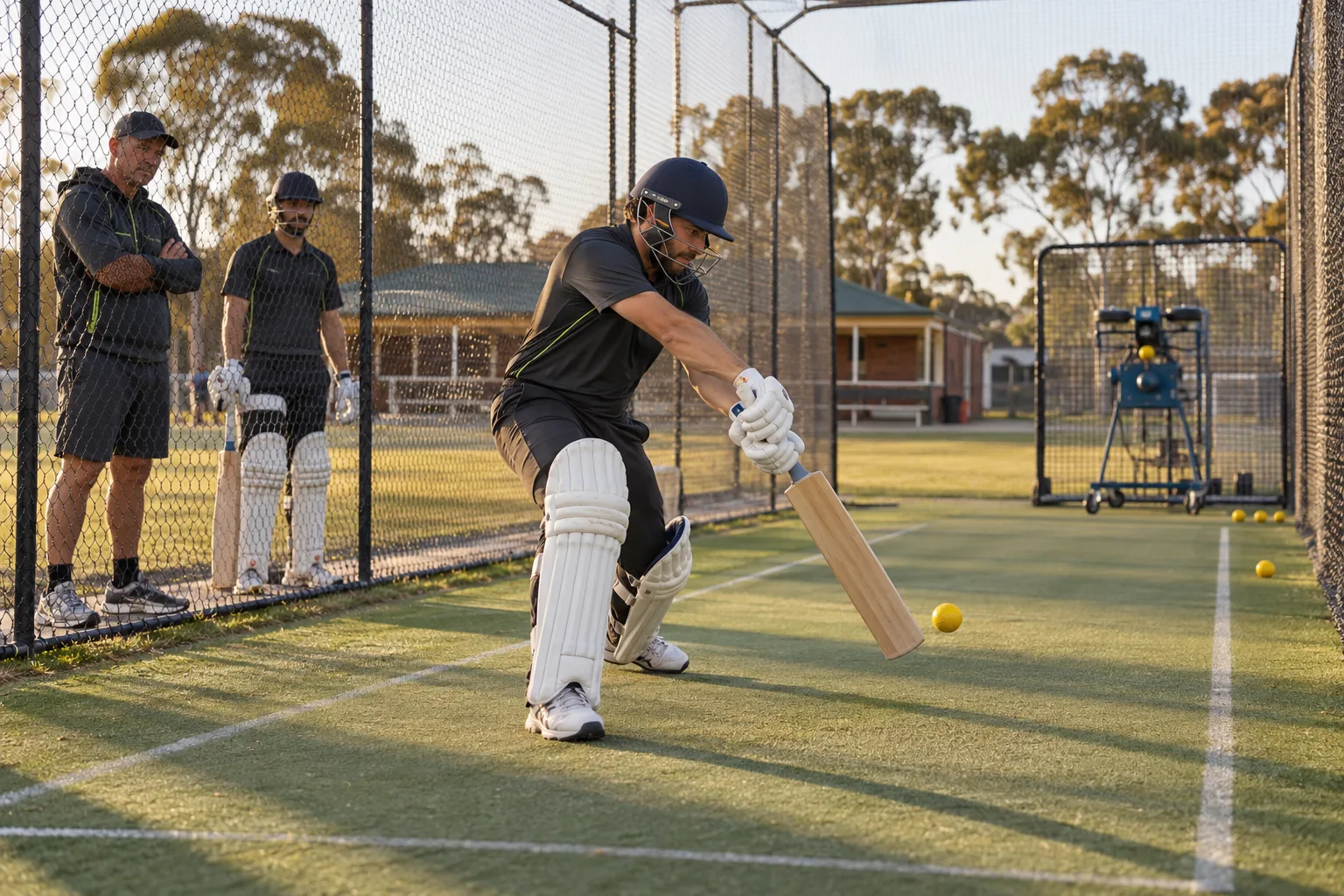
Specific practice develops specific skills. Our approach follows the deliberate-practice principles described in Peak: a clear target, an appropriate challenge, focused attention, feedback and refinement. [peak][practice]
“Place a good-length ball through this gate” is actionable. “Get better at batting” is not a session goal. The coach chooses a task from an observed need.
Work in focused 6–12-ball blocks, with the coach adjusting their length to the task and player. Keep a task challenging enough to reveal an error and manageable enough to work on it.
The player describes the attempt. The coach adds one useful observation, supported by a clip where helpful. Try one change, then compare.
Revisit the task on another day without constant prompts, then against live bowling. Check that the skill holds with fewer prompts and in changing conditions.
The coach identifies the element to improve, designs the task and uses feedback to refine the next attempt. Strength and conditioning follow the same clarity of purpose: select the capacity, train it progressively and track it over time. Quality, challenge and recovery give practice its direction. [debate][reply]
02 / WHAT A BATTER DEVELOPS
Batters use visual information to anticipate the delivery and coordinate the stroke. Eye-tracking research shows how gaze and head movement work together during interception. [gaze]
WBL application: practise reading the delivery, choosing a response and executing the stroke together. Track decision accuracy at a defined level of difficulty.
Bat speed and impact location contribute to the pace of the struck ball. Batting research also links upper-body strength with maximum hitting distance. [contact][power]
WBL application: develop centred contact, controlled direction and appropriate attacking intent. Refine the movement around the player and the task.
Progressive resistance training builds strength, power and physical function in healthy adults. Training through an appropriate range of motion also develops movement capacity. [strength][mobility]
WBL application: scaled squat, hinge, push/pull and carry patterns; comfortable movement and progressive load.
Train acceleration for speed, rehearse turns for efficient running, and develop aerobic fitness through sustained and interval work. Research supports strength training for sprint development and endurance training for aerobic capacity. Measure running, conditioning and contact skill separately. [sprint][aerobic] [running]
WBL application: acceleration, braking, turns and calls; an aerobic station with enough recovery to preserve useful practice.
Pre-performance routines support performance across sporting tasks. Rehearse a short, personal sequence so you have a familiar process to use before the next ball. [routine]
WBL application: practise a clear intention and a repeatable reset, then rehearse them under progressively more demanding scenarios.
Exercise research links autonomous motivation and a sense of competence with participation. Give players ownership of their goals and visible evidence of their progress. [community]
WBL application: player choice, supportive partners, visible personal progress and optional comparable challenges.
Machines let the coach repeat a delivery and isolate a task. Live bowling adds the approach, release cues and variation of a bowler. Research shows that these information sources shape batting movement. Use both deliberately: refine the task, then read and respond to the complete delivery. [machine]
03 / SIX WAYS TO TRAIN WITH PURPOSE
The theme connects all six stations. Players work at their own delivery profile and physical level. The coach adjusts the exercise, workload and challenge to each player. This playbook covers supervised adult groups; junior sessions use age-appropriate programming.
THEME 01
Player intention: A controlled stroke through a chosen gate.
Predictable comfortable feed; one contact cue and a broad straight gate.
Choose between two scoring gates; retain contact quality as uncertainty rises.
Supported split squat + band row; controlled movement, no fatigue target.
Three smooth 10 m starts, full recovery; learn a balanced stop.
Easy walk/run; arrive at the next batting task ready to concentrate.
Comfortable hip/ankle movement; review one clean contact and one next action.
Look for: Controlled contacts / attempted strokes; target hits / valid task deliveries. Correct leaves are recorded separately.
THEME 02
Player intention: A sensible leave, defend or score decision.
Explain the playable zone; contrast two delivery types at suitable pace.
Coach-managed line/length variation; batter chooses leave, defend or score.
Light hinge + anti-rotation press; keep physical demand moderate.
Partner call-and-go over 10 m; avoid guessing the call.
Easy intervals; protect attention for the decision task.
Player explains the cue used to decide; compare it with video.
Look for: Correct decisions / valid deliveries, alongside execution quality. Confirm transfer with live-bowler cues.
THEME 03
Player intention: Place the ball, call clearly and complete the run.
Controlled placement into a marked gap; full attention to the stroke.
Field-map scenario: when is a single available? Score choice and placement.
Supported split squat + short suitcase carry, changing sides.
Three or four separate single/turn rehearsals; clear yes/no/wait calls, safe lanes.
Four easy run/walk rounds; no punishment laps for missed calls.
Partner agrees caller responsibilities; rehearse the next-ball reset.
Look for: Placement rate, correct run decision, call clarity and clean grounding. Running speed remains a separate measure.
THEME 04
Player intention: Increase useful ball speed without losing the task.
Comfortable range-hitting task into a safe designated target; locate the middle.
Choose the appropriate attacking ball; defend or leave the others.
Squat/hinge + row. Experienced players may substitute a few light medicine-ball throws into a supervised clear zone.
Three quality accelerations with full recovery; no speed endurance finisher.
Easy recovery movement to support quality contact and powerful efforts.
Review whether contact or decision changed as intent increased.
Look for: Contact and safe target success at the same feed. Compare execution as attacking intent increases.
THEME 05
Player intention: Sustain decisions and contact over a sequence.
Build a short sequence around one reliable scoring option.
A declared innings scenario; adapt scoring intent to wickets, field and target.
Manageable strength sets; stop before form deteriorates.
Rehearse a single and a turn with recovery; controlled repeatability.
Four 20-second run / 40-second walk rounds; scale to the player, log effort.
Notice attention and effort; use the personal routine before the next block.
Look for: Compare early and late task quality at recorded effort. Track decisions, contact and routine across the sequence.
THEME 06
Player intention: Return attention to a useful action after each ball.
Choose a familiar scoring option and rehearse the same short routine.
Opt-in scoreboard challenge at a suitable level; no public shaming or exercise penalties.
Familiar, comfortable movements; low complexity and modest load.
Partner calling under a simple scenario; accuracy before speed.
Easy social run/walk; keep physiological load moderate.
Breathe, choose, commit; reflect on what was controllable after a miss.
Look for: Routine use and decision quality at comparable difficulty. Ask the player how pressure felt and which cue helped them refocus.
Build a reliable response in a familiar task, then introduce variation suited to the learner. Choose the practice structure around the skill being developed. [variation] Theme order is flexible. Plan the week: alternate technical/easy sessions with appropriate strength or conditioning work, account for matches and other training, and schedule recovery.
04 / THE STATION PLAYBOOK
Seven-minute windows include instruction, work and rest. The coach sets repetitions and recovery to maintain quality. Remove pads and helmets for strength and general conditioning. Keep full appropriate protection in the batting nets.
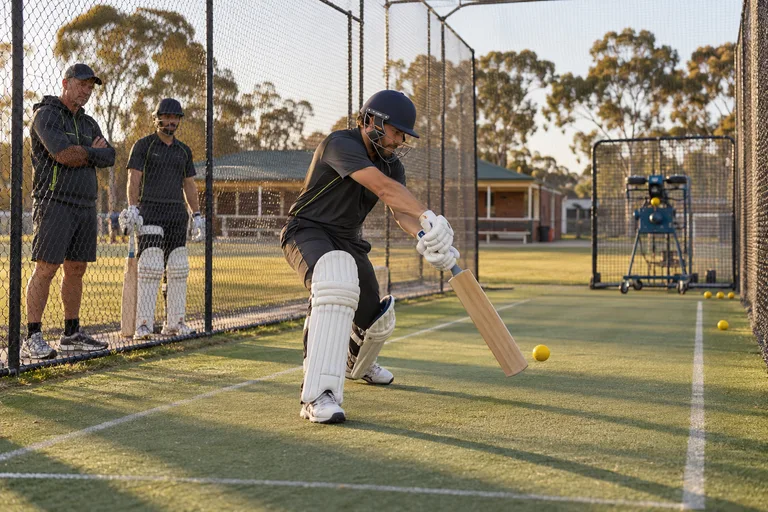
Perception → movement → contact
Session task: Choose one delivery profile and one target. Alternate short 6–12-ball blocks within equal time allowances. The partner observes outside the active lane; the coach pauses the machine for changes. Ask the batter what happened before giving one cue.
Scale & progress: Start with a comfortable feed and a wide scoring gate. Progress direction or delivery variation before simply adding pace. A correct leave can be the intended success.
Measure: Log valid deliveries, attempted strokes, controlled contacts and target hits separately. Compare like-for-like profiles.
Research context [practice][machine]. The coach adapts the workload and progression to the player.
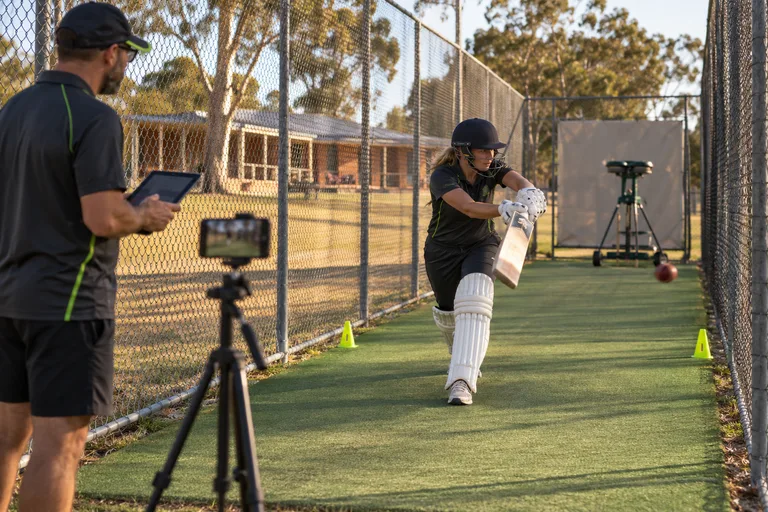
Reading → selection → execution
Session task: Set a field and a scoring problem: defend, leave or score into an available space. Introduce coach-managed variation with suitable equipment, stopping for setting changes. No person approaches an operating machine.
Scale & progress: Start with two clear options, then vary line or length. Add a scoreboard only once the task is understood. Schedule live bowling in separate practice blocks; it requires its own staffing and delivery plan.
Measure: Score the decision independently of the outcome. An edged boundary is not automatically a good decision.
Research context [machine][feedback]. The coach adapts the workload and progression to the player.
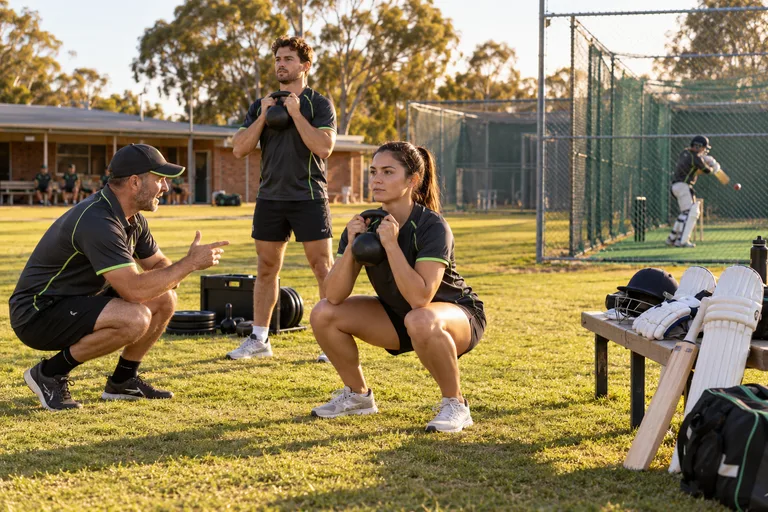
Force production → control
Session task: Choose two movements for the theme: squat or supported split squat; hinge or carry; row or anti-rotation press. Starting dose: two sets of 5–8 controlled repetitions per exercise, or short carries, with 45–75 seconds recovery as needed. Use the time ceiling, not a race to finish.
Scale & progress: Begin with bodyweight or light resistance. Leave several comfortable repetitions in reserve. Add a small load only when the chosen range and control are repeatable. Use separate supervised strength sessions where a fuller dose is needed.
Measure: Record exercise, load, repetitions and comfort. No maximal lifting tests in the circuit; strength is not a batting-grade gate.
Research context [strength][power]. The coach adapts the workload and progression to the player.
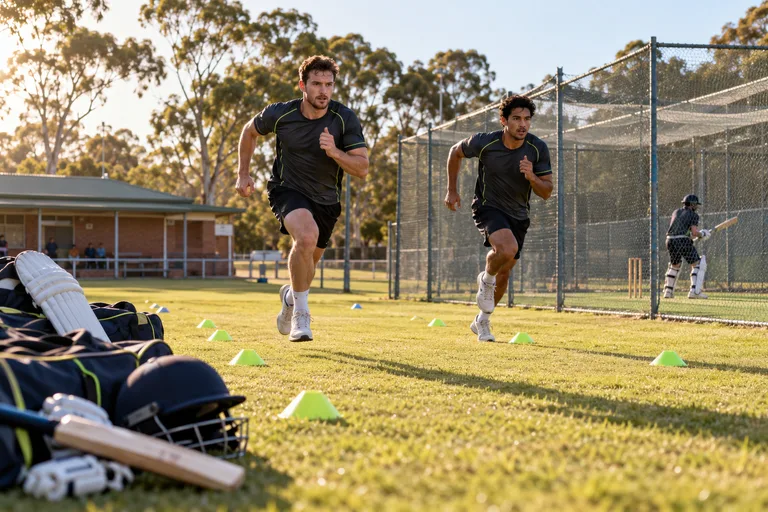
Acceleration → braking → calling
Session task: After progressive warm-up, choose either 3–4 controlled 10–20 m accelerations with 60–90 seconds recovery, or 3–4 single-run/turn rehearsals with a partner and full recovery. Do not add both full doses. Mark separate outbound lanes and generous run-off.
Scale & progress: Learn braking, bat grounding and the call at walking pace, then increase speed. General conditioning is unpadded. Introduce controlled cricket-specific running with bat and protection only when the coach judges it appropriate. Never run through an active net.
Measure: Time fresh efforts only with a consistent method. Log clean turns and clear calls separately. A 20 m sprint is a conditioning task, not the exact distance a batter travels for a run.
Research context [running][strength]. The coach adapts the workload and progression to the player.

Aerobic capacity → recovery between efforts
Session task: Starting option: 4 rounds of 20 seconds comfortable running and 40 seconds walking, then recover. Alternatively use an easy, measured loop with a walk/run option. Keep this station easy on precision and speed days. Progress total weekly conditioning with the player’s fitness. Experienced players use additional conditioning sessions to meet their training needs. [aerobic]
Scale & progress: Increase total manageable work before intensity; change one variable at a time. A measured 400 m can be an occasional separate benchmark, not an all-out daily requirement. Replace running with accessible low-impact movement where appropriate.
Measure: Record duration, distance if measured and perceived effort on the same scale. Fitness improvements do not by themselves demonstrate better batting.
Research context [running][community]. The coach adapts the workload and progression to the player.
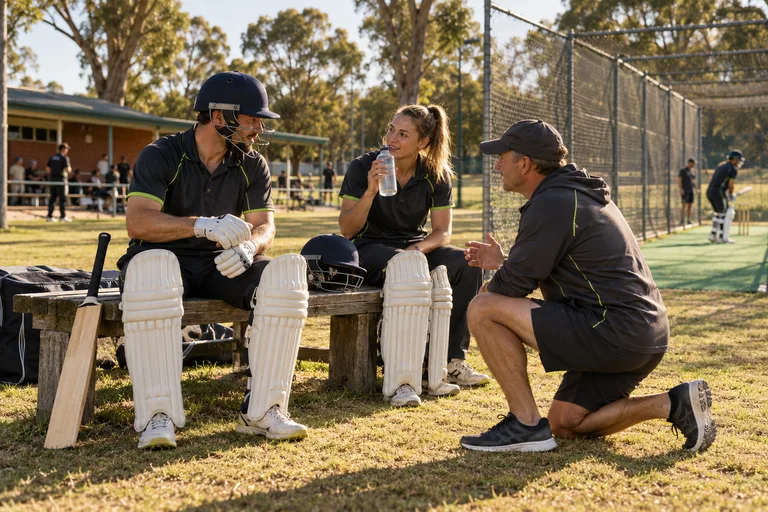
Mobility → attention → readiness
Session task: Water and a short check-in; choose gentle ankle rocks, hip movement or thoracic rotation within a comfortable range. Rehearse a personal between-ball routine: step back, breathe, choose one intention, commit. Leave enough time to pad up.
Scale & progress: Use support or a smaller range where needed. Do not force stretches or chase arbitrary symmetry targets. The routine should be brief enough to use in a match.
Measure: Player names the next task in their own words. Record comfortable movement range, readiness and use of the routine.
Research context [mobility][routine]. The coach adapts the workload and progression to the player.
If fatigue, heat, discomfort or loss of attention compromises the task, reduce work, rest or stop. Use a progressive warm-up before faster running. Keep machinery, ball collection, running lanes and lifting zones separate. A replenisher is not also the strength supervisor: the lead coach needs clear sightlines and manageable tasks; add supervision or simplify where that is not possible. Allow more than a minute for gear changes when needed, even if ball volume falls.
05 / MAKE IT WORK AT YOUR NETS
The standard adult format is 8 minutes of readiness, warm-up and briefing; six rounds of 7 minutes plus 1 minute to transition; then 4 minutes to reflect. Setup and pack-down happen outside the hour. Rotate starting stations between visits.
ONE NET / DECISION LAB
Replace Net B with a protected off-net station: pause a previously selected batting clip before the outcome, state a decision, explain it, then compare with the coach’s task and the actual delivery. Use shadow movement only in a clear area, without live balls.
Use this station to rehearse anticipation and explain decisions, alongside the player’s on-ball practice. One-net players receive half the planned batting time in this six-station format.
ODD NUMBERS / EQUAL DOSE
Each player has up to 3½ minutes of active batting per net visit. A solo player uses the rest for recovery, self-review or a coach check-in; the machine is stopped. Never double their workload just to keep a feeder busy.
Use a coach or stationary caller for solo calling drills; no one leaves another active station unsupervised. Rotate solo roles between classes. Extra coaching time is useful even when machine utilisation is lower.
Create three pods with at most two players each (empty pods are allowed). Use three 16-minute rounds: 14 minutes including work/rest plus 2 minutes to transition. Rotate through Batting, Movement and Running/Reset. Every pod visits each zone once; the outer 8-minute warm-up and 4-minute reflection remain.
Each player has up to seven active batting minutes in the Batting zone, split into short blocks; solos rest/review for the other seven. Divide Movement between two familiar strength exercises and mobility; divide Running/Reset between a few recovered running efforts and preparation. This is a different, simpler programme, not all six full stations squeezed into one. With 1–2 players, stop machinery while the coach accompanies the player elsewhere. Two nets are unnecessary for this compact format.
The planner uses the founder-reported operating reference of 500 deliveries per net-hour from previous machine sessions with dedicated replenishment. The class estimate allows equal batting time; actual counts depend on coaching, feeds, handovers and readiness. A ball every seven seconds is approximately 514/hour before pauses.
06 / PROGRESS THAT MEANS SOMETHING
Record the task, feed distance, machine settings, ball type, target, surface and player state. Observe a manageable fresh block before hard conditioning, even if it takes a separate assessment visit.
Progress target precision, delivery uncertainty, pace or scenario pressure one at a time. Reduce difficulty if the task stops revealing useful solutions. Changing every variable makes comparison meaningless.
Repeat a comparable task on another day with fewer prompts. Then assess decisions and execution against live bowling. Track performance across repeated situations and use match footage to identify the next training priority.
| Profile | Evidence to look for | Next challenge |
|---|---|---|
| Foundation | Safe preparation, understood task and manageable feed. | Repeat an intentional contact or correct leave. |
| Control | Repeatable contact and target execution on more than one day. | A second direction or delivery type. |
| Adapt | Useful choices with controlled variation; skill retained without constant cues. | A representative live-bowler task. |
| Apply | Coach-observed decisions and execution transfer across live-bowling situations. | A more demanding scenario while preserving the useful action. |
Agree the task-specific success criteria before the block. Local grades use defined coaching criteria. Keep separate records for batting, fitness and consistency so each reflects the element being developed.
Report small samples as counts as well as percentages. Use the same rubric; have coaches independently score a sample of clips and resolve disagreements before comparing groups.
WBL records sessions and supports shot review. The coach selects useful moments and connects them to a task. The coach assesses the decision and execution, then chooses the next task.
Cricket research examines feedback within skill-learning and anticipation programmes. Our coaching loop puts footage to work: observe the attempt, explain the decision, adjust and repeat. [feedback]
Use video to review visible actions and outcomes. Record contact, decisions and task execution on the coach scorecard; use dedicated measurement equipment for speed or force assessments.
Example six-week coaching block: establish a fresh task and personal goal; practise it across suitable themes; revisit without prompts; add live-bowling checks; compare with the original task and discuss the next block. Review the block after six weeks and set the next goals from the player’s results.
07 / THE EVIDENCE, OPEN TO INSPECTION
Focused skill practice develops the task being trained. Progressive resistance training develops strength. Endurance training develops aerobic capacity. WBL organises these elements into a coherent coaching programme.
Each station has a defined training purpose and an observable measure. The sources below explain the evidence for the underlying elements, the populations studied and how we apply the findings.
Research review: 23 October 2026. Targeted evidence review, not an exhaustive systematic review. Searches covered deliberate practice, cricket perception and biomechanics, feedback, physical preparation and sport psychology. Primary research and research syntheses were prioritised. Access level is stated below; abstract-only findings are kept to what the abstract reports. Much batting evidence uses small male samples; applicability to women, juniors, returning players and different formats must be assessed rather than assumed. Specific station doses and rotation rules are WBL coaching proposals.
Improvement-directed tasks, attention, feedback and refinement underpin deliberate practice. Much of the original empirical work concerned musicians. The emphasis is on the structure and quality of practice.
The inspiration for our practice philosophy. The book presents the research for general readers. We use the primary research alongside it.
Practice and performance are related, but practice measures do not explain all differences between athletes. Observational associations cannot establish how much a particular player will improve.
Challenges broad definitions of deliberate practice in the meta-analysis. The distinction centres on task quality, individual goals and informative feedback.
Two elite and two club batters showed differences in gaze and head tracking. This very small comparison describes behaviour; it does not prove that copying a gaze pattern produces expertise.
Changing live-bowler, machine and video information changed movement organisation. A short experimental comparison, not a long-term training trial. Machine success needs a transfer check against live bowling.
Eleven studies were included, five in meta-analysis. No study isolated feedback alone; anticipation interventions commonly combined methods. The review informs how coaches combine feedback with a defined learning task.
In 18 elite provincial male batters, upper-body strength related to maximum hitting distance, but not significantly to batting average or strike rate. Association is not proof that a particular strength programme causes more runs.
Twenty batters performed a range-hitting task. Bat speed and impact location were related to ball speed. Controlled-task associations do not establish a single ideal technique or justify forcing a player into maximal trunk rotation.
An overview of 137 reviews supports progressive resistance training for strength and physical function in healthy adults. It is not cricket-specific evidence, and a seven-minute station is not equivalent to a complete strength programme.
Across 55 studies, resistance training with external loads improved range of motion. The evidence concerns range of motion in general training populations.
Twenty-two male club batters completed a prolonged intermittent batting simulation. Contact distinguished standards more clearly than the other reported physical measures. The protocol’s reliability cannot be transferred to a different WBL test.
Evidence across sports supports pre-performance routines. Tasks and populations vary; coaches adapt the routine to the athlete and performance setting.
Findings do not support a universal advantage for random over blocked sports practice. Appropriate variation is a coaching decision; more uncertainty is not always better for a learner.
Autonomous motivation and perceived competence are associated with exercise participation. Much of the evidence is observational. The class applies these principles through player choice, supportive partners and achievable goals.
Fifteen studies involving 510 participants linked improvements in squat strength with sprint improvement. This supports physical preparation alongside running practice; it does not validate the WBL station dose, wicket turns or a guaranteed speed gain.
Twenty-eight studies in healthy adults aged 18–45 supported aerobic fitness gains from endurance and interval training. Study protocols differ from this class. A short easy station is not a demonstrated sufficient training dose; weekly volume, progression and starting fitness matter.
THE SPORT OF BATTING
One useful goal. A coach who notices. A group that helps you keep showing up.